
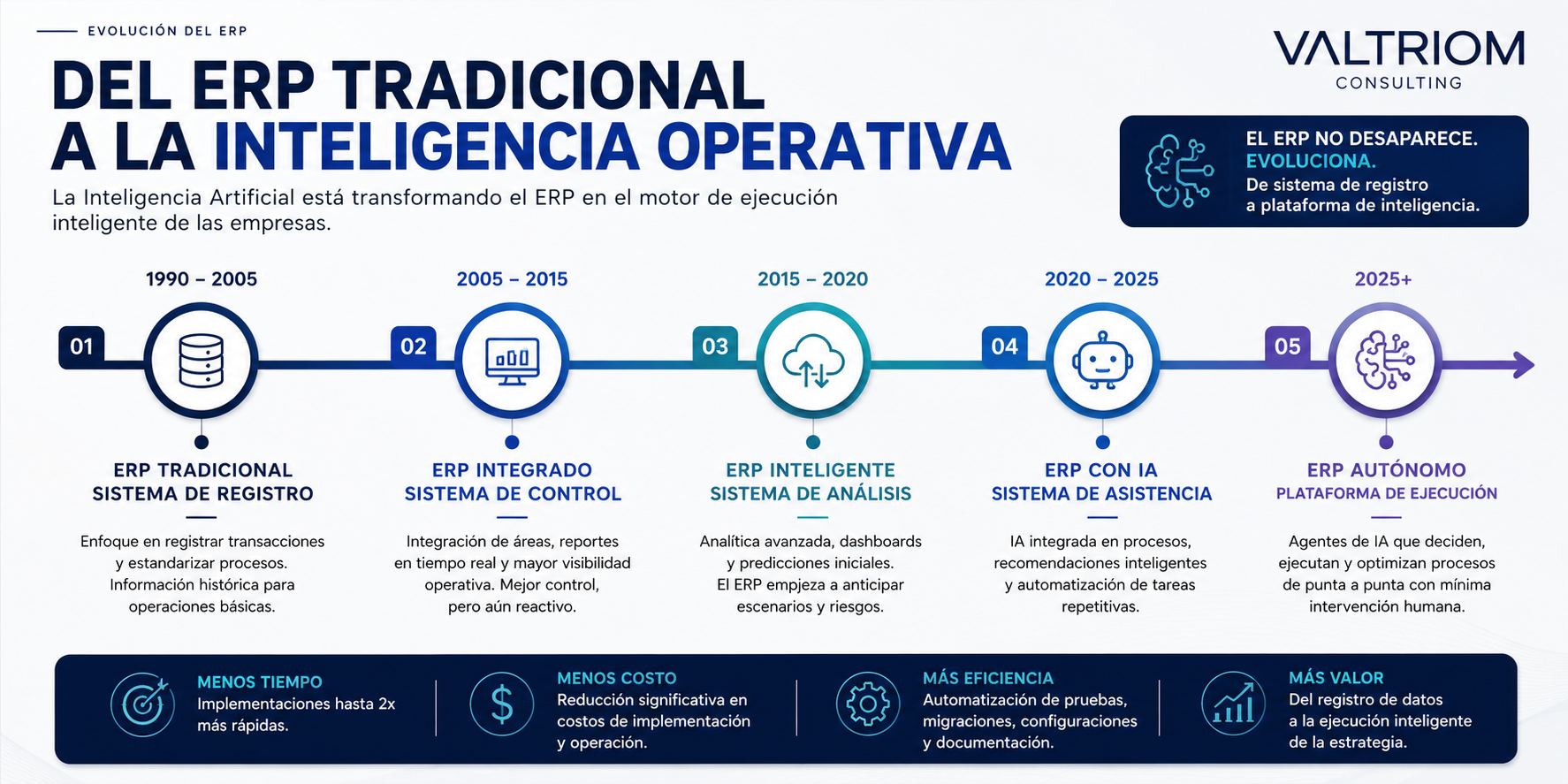
For more than three decades, ERPs were seen as the operational center of modern companies. Systems designed to control inventory, record sales, manage finances, handle purchasing and structure internal operations. For many business owners, implementing an ERP meant “digitizing the company.” And for years, that was enough. But the market changed. The speed of business changed. Customer expectations changed. And now, Artificial Intelligence is beginning to quietly destroy the logic on which most traditional ERPs were built. What used to be a system of record is evolving into something completely different: an operational intelligence platform capable of analyzing, recommending, automating and eventually making decisions inside the company. And although many companies still don't understand it, this transition has already begun.
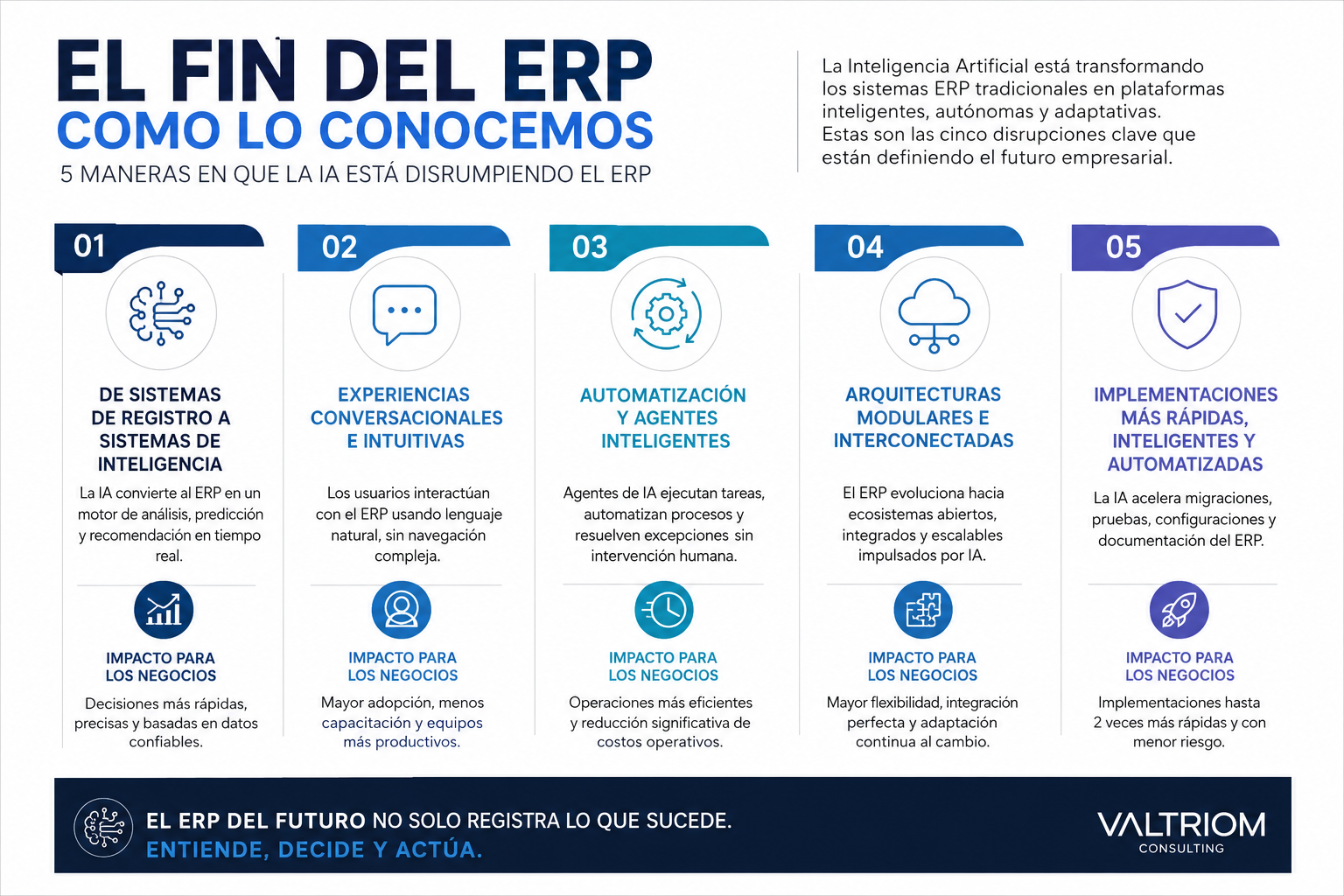
Most companies still operate under an extremely reactive model. They wait for reports to make decisions. They wait for meetings to detect problems. They wait for an employee to discover errors manually. They wait for month-end closes to understand what happened financially. But Artificial Intelligence is destroying that slow model. New business environments run on continuous analysis, constant monitoring and intelligent automation. The system no longer waits for a human to detect the problem. It now starts identifying patterns, anomalies and risks before they turn into real crises. This completely changes a company's operating logic. Because when the speed of analysis increases, the speed of execution changes too. And in highly competitive markets, operational speed starts to become an advantage more important than even the size of the company.
One of the most disruptive changes will be the gradual disappearance of the complex interfaces that dominated corporate software for decades. For years we trained employees to learn difficult systems: endless menus, complex modules, technical forms and rigid processes. But Artificial Intelligence is completely reversing that relationship. Now the system will begin to adapt to the user. Instead of forcing the manager to learn how the ERP works, the ERP will learn how the manager thinks. This means that in the coming years we'll see executives interacting with business systems through natural language, requesting analyses, automations or decisions without having to navigate complex technical structures. And this isn't a futuristic vision. It's already starting to happen.
However, there's an uncomfortable truth here that many companies still don't want to accept: Artificial Intelligence doesn't fix operational chaos. It multiplies it. Many organizations are desperate to implement AI while they still operate with improvised processes, messy data, duplicated information, extreme dependence on individuals and completely disconnected internal structures. And that is extremely dangerous. Because automating a bad operation doesn't create efficiency. It creates errors faster. AI needs structure. It needs clear processes. It needs traceability. It needs consistent data. Without that, any technology initiative ends up becoming an additional layer of complexity on top of an already weakened operation. That's why the companies that will dominate this new era won't necessarily be the ones with the most technology tools, but the ones with the strongest operational fundamentals.
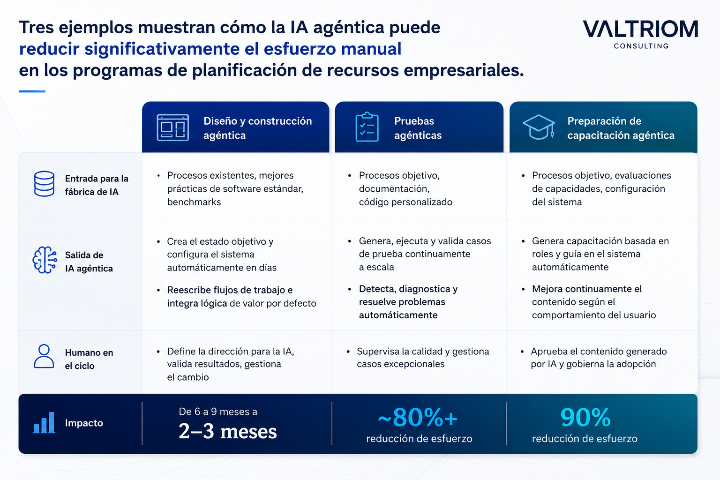
Traditional ERP implementation is also entering a crisis. For years, ERP projects were long, costly and extremely draining processes for companies. Months of configuration, traumatic migrations, endless documentation and constant dependence on technical consulting. But Artificial Intelligence is starting to automate much of that work. Today there are already tools capable of analyzing processes, recommending configurations, generating documentation automatically, detecting operational inconsistencies and even automating functional testing. This will drastically reduce implementation time and costs. But it will also force technology consulting firms to evolve. Because the market will no longer pay just to configure screens or move data between systems. The real value will begin to lie in designing enterprise architecture, optimizing operations and building intelligent operating models.
The problem is that many companies still believe digital transformation means buying software. And that's probably one of the costliest mistakes of this decade. Real digital transformation was never technological. It was always operational. Technology only accelerates what the company already is internally. If the organization is efficient, technology amplifies efficiency. If the organization is disorganized, technology amplifies disorder. That's why the world's most advanced companies are investing enormous amounts of money not only in AI, but in data governance, process documentation, structured automation and operational architecture. Because they understood something fundamental: Artificial Intelligence needs order to produce real value.
Another profound change is that the ERP will stop being the company's visible protagonist. For decades, the ERP was “the system.” Everything revolved around it. But in the coming years it will start to become something much quieter: the invisible infrastructure that supports distributed operational intelligence. On top of the ERP, intelligent agents, autonomous automations, predictive engines and business assistants will operate, capable of coordinating entire tasks without constant human intervention. The ERP will still exist, but it will no longer be the visible center of the business experience. It will become the governance and traceability layer that feeds far more intelligent and dynamic systems.
This will also completely change the workforce structure inside companies. Many repetitive operational tasks will gradually begin to disappear. Processes that used to require several people will be carried out by intelligent automations capable of analyzing information, coordinating activities and generating actions automatically. But this doesn't necessarily mean fewer companies or less growth. It means more efficient, faster companies with far more strategic structures. Human teams will stop concentrating on repetitive tasks and start focusing on oversight, strategy, creativity and high-value decision-making. The company of the future won't be the one with the most employees. It will be the one with the greatest capacity for intelligent execution.
Small and medium-sized businesses will also be deeply impacted by this transformation. For years, many technology capabilities were reserved for large corporations because of their high implementation costs. But AI is democratizing extremely advanced tools. This means a small company with a good operational structure could compete against much larger but slow and disorganized organizations. In other words, operational speed will begin to beat company size. And that will completely change the rules of competition in practically every market.
The most important question is no longer which ERP a company will use. That conversation is behind us. The real question now is whether the organization is ready to operate in an environment driven by artificial intelligence. Because the future won't belong to the companies with the most software. Nor to those with the most isolated automations. The future will belong to the companies capable of turning their processes, data and operations into executable intelligence. And the organizations that understand this early will build competitive advantages that will be extremely hard to match for those who keep operating under the business models of the past.